Return-to-work (RTW) matching
Suitable duties, matched to the real job.
When a worker is injured, the RTW coordinator has to work out what they can safely do. Etiscope already holds the measured physical demands of the tasks in each role. Return-to-work matching uses that evidence to show, task by task, which duties fit the treating practitioner's restrictions, and why.
Available today as an engagement built on your task demands library. The RTW Matchmaker module is in development.
The problem
Return-to-work decisions are made without the job's measured demands.
The duties a worker can do while they recover are agreed between the worker, the employer, and the treating practitioner. Each sees a different part of the picture, and none of them has the measured demands of the work in front of them.
The doctor doesn't know the job
A treating practitioner certifies capacity from a short consultation and the worker's description of their work. Without knowing what the tasks actually involve, the safe default is to certify no capacity, or restrictions so broad that no duties fit.
“Modified duties” is not a plan
Job descriptions say a role “occasionally lifts objects”. That gives neither the doctor nor the coordinator anything to judge a 5 kg lifting limit against, so duties are negotiated rather than matched.
Every certificate restarts the work
Certificates are renewed every few weeks. Each new one means re-checking every task by hand, re-agreeing duties with the worker and the line manager, and re-writing the plan.
Suitable-duties lists go stale
Where an employer keeps a list of light duties or a job dictionary, it was usually written once, by hand, and drifts from the work as equipment and layouts change.
Who's involved
One coordinator runs the case. Everyone else gets what they need.
Uses the platform
RTW coordinator
Opens the case, records the restrictions, chooses the duties, agrees the plan with the worker, and copies it into the RTW form. Often a safety or HR professional doing return-to-work alongside other work.
Receives an agreed plan
Treating practitioner
Gets a one-page suitable duties plan the worker and coordinator have already agreed, before the appointment, after the certificate, or both. No login, and no video or report to work through.
Consulted and agrees
Worker
Talks through the duties with the coordinator and agrees they are suitable before anything goes to the doctor. Carries the plan to the appointment, and isn't named in the platform.
Confirms the duties work
Line manager
Answers one short checklist: the duties exist, the cover is in place, the schedule works. Recorded by the coordinator; no account needed.
How a case runs
8 steps from injury to suitable duties.
The steps repeat at every new certificate. This walkthrough follows one fictional case: a line operator in a packing team with a right shoulder injury. The role has six tasks. Most of them fit the restrictions. Two need a decision.
- 1
Open the case
Case reference, site, pre-injury role, injured body region, consent.
- 2
Plan before the appointment
Duties agreed with the worker from the role and the injured region, for the doctor to endorse.
- 3
Restrictions
Entered exactly as written on the certificate.
- 4
Suitable duties
Every task checked against every restriction; open items resolved.
- 5
Schedule
Hours and days week by week, within the certificate.
- 6
Agree
The worker agrees; the line manager confirms. Version 1.
- 7
Agreed plan
One page to the clinic and the worker, copied into your RTW form. Duties start.
- 8
Next certificate
Re-match, show what changed, re-agree only the changes.
Loop: each new certificate returns to step 3. Only what changed is re-agreed.
Branch: a strain reported before any claim goes straight to stepping back from the tasks that aggravate it.
Underneath: the task demands library supplies the measured demands for every step.
Steps 1–2 · Open the case, agree a plan before the appointment
The doctor sees duties the worker has already agreed.
The coordinator opens the case on the worker's pre-injury role. The platform already knows every task in that role and what each one physically involves, so the coordinator records only the injured body region, the dates, and the worker's consent. No name goes into the platform.
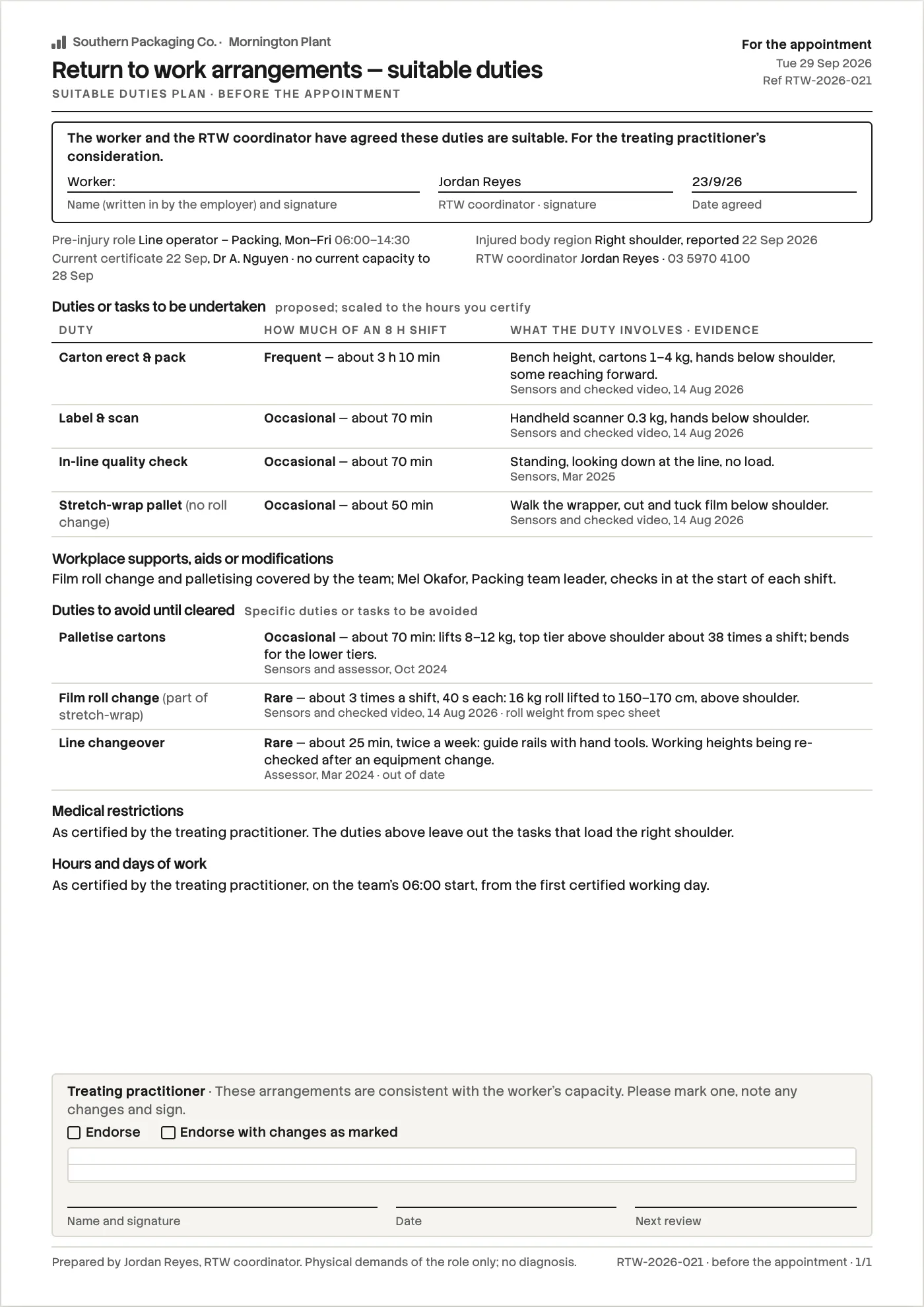
Before the appointment, the platform drafts a suitable duties plan from the role and the injured region. Tasks that load the injured shoulder are set aside until cleared; the rest are proposed, each with how often it's done: "Frequent, about 3 h 10 min a shift". The coordinator agrees it with the worker, who takes it to the appointment. The doctor can endorse it, change it, or certify differently.
The occupational physicians we work with are clear: doctors don't want a document from the employer. They want a return to work that the worker and the coordinator have already agreed.
Step 3 · Restrictions
Restrictions recorded exactly as the doctor wrote them.
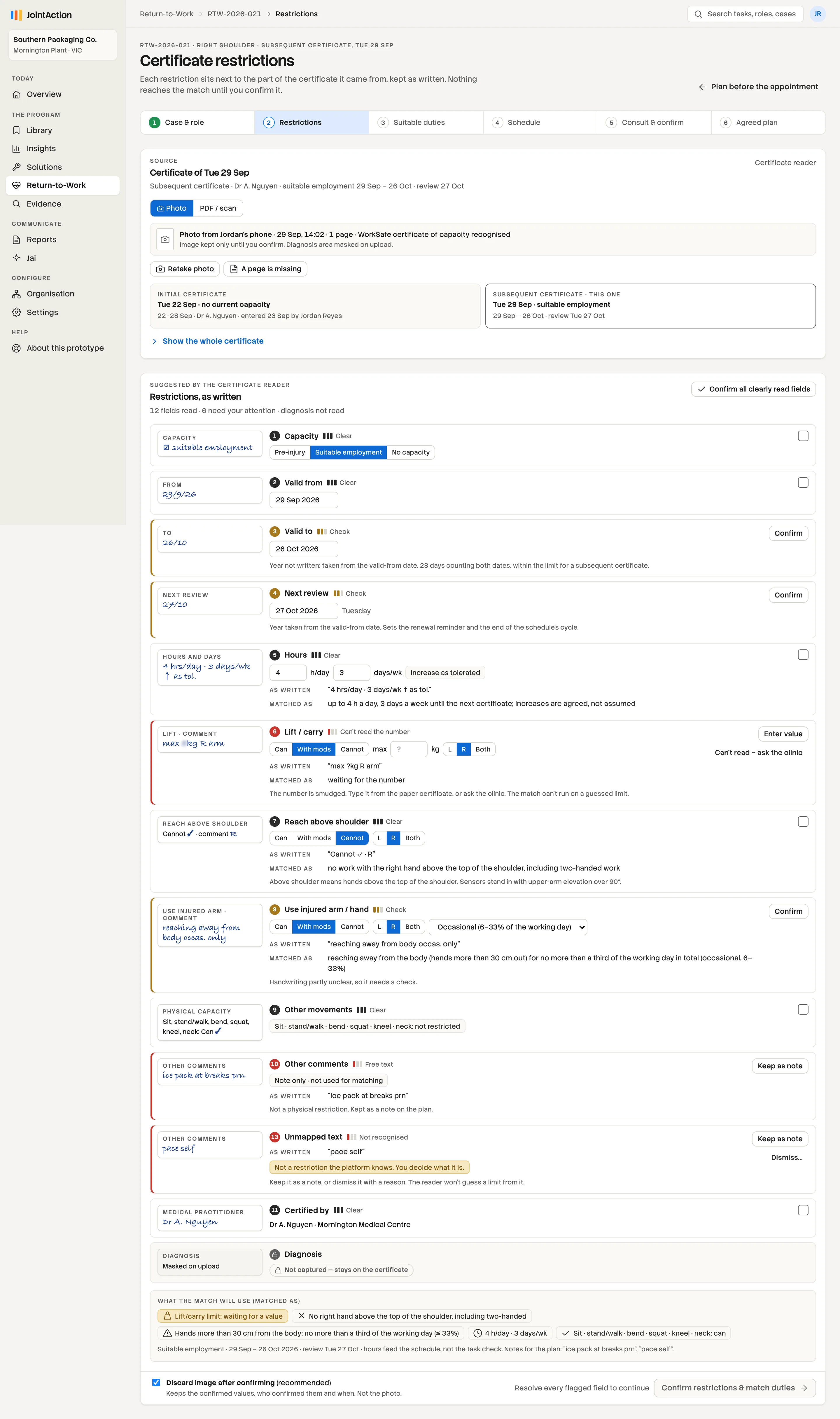
The coordinator enters the certificate in its own layout: Victoria's can / with modifications / cannot items, New South Wales's capacity boxes, or a US work status report. Each restriction keeps its original wording, and it's printed that way on everything that follows.
Where matching needs an interpretation, the platform shows it next to the original. "Reaching away from body occasionally only" is matched as occasional: no more than a third of the working day. If a restriction can't be read conservatively, the platform asks the clinic rather than guessing.
The diagnosis is never recorded. It stays on the certificate.
Step 4 · Suitable duties
Every task, checked against every restriction.
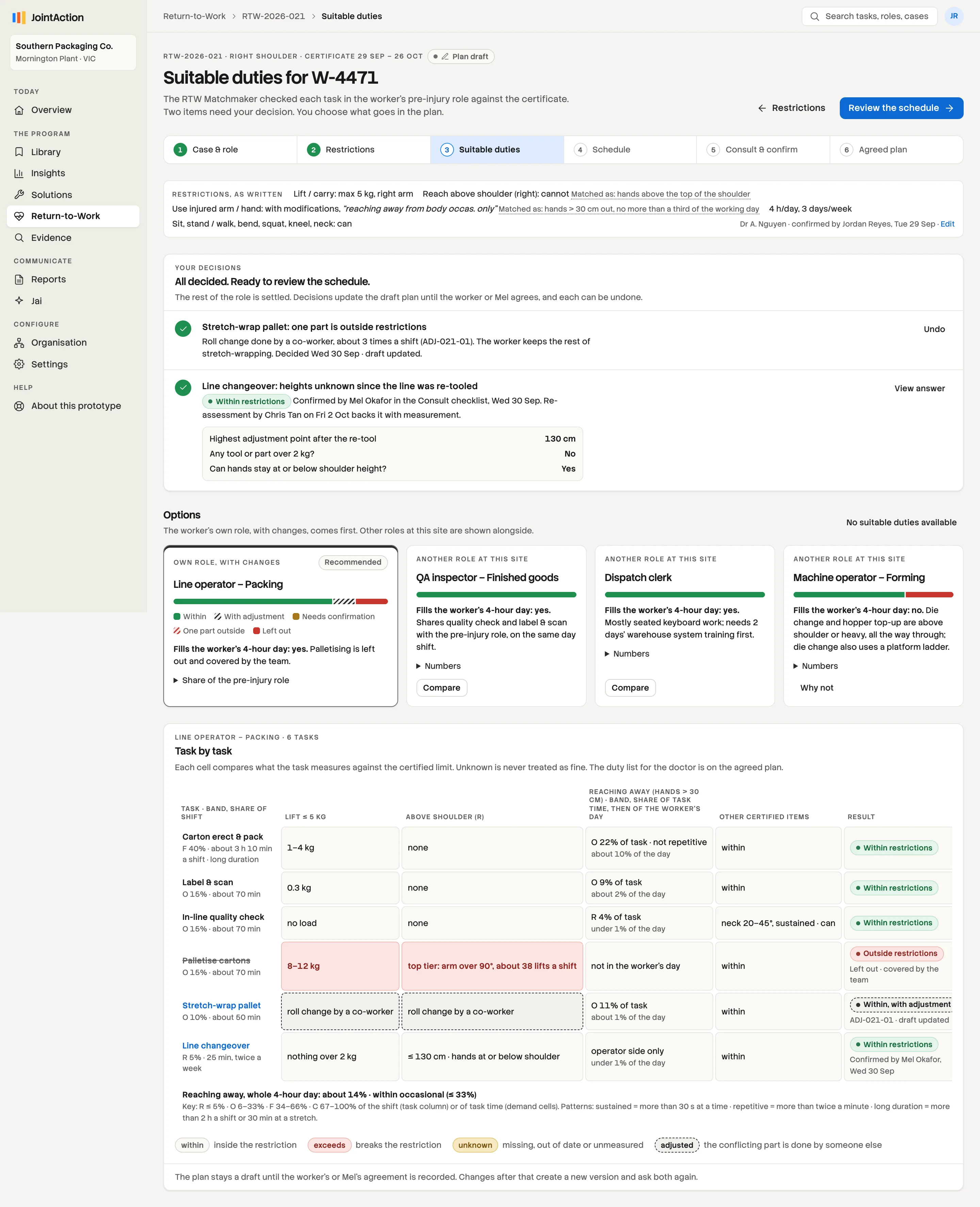
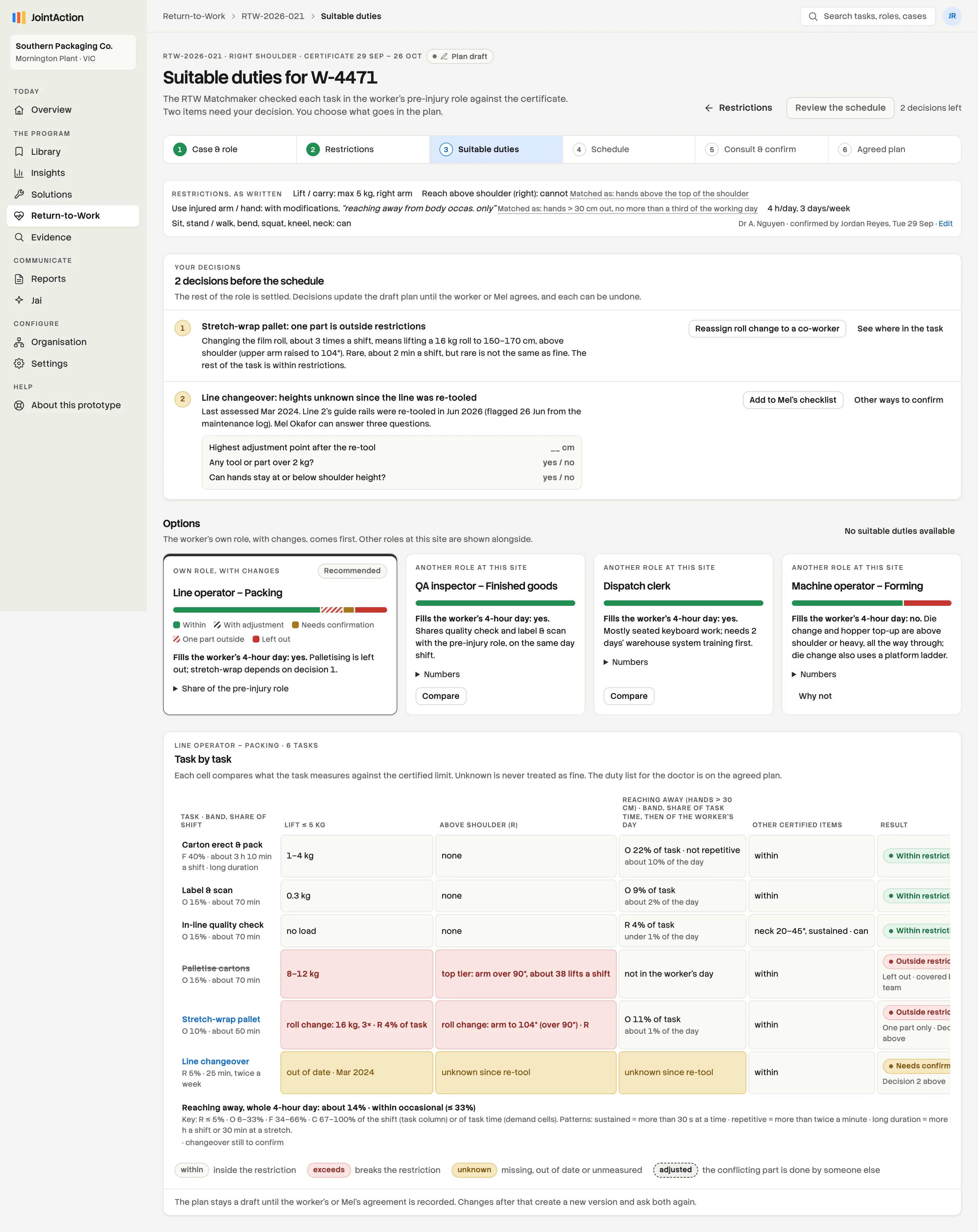
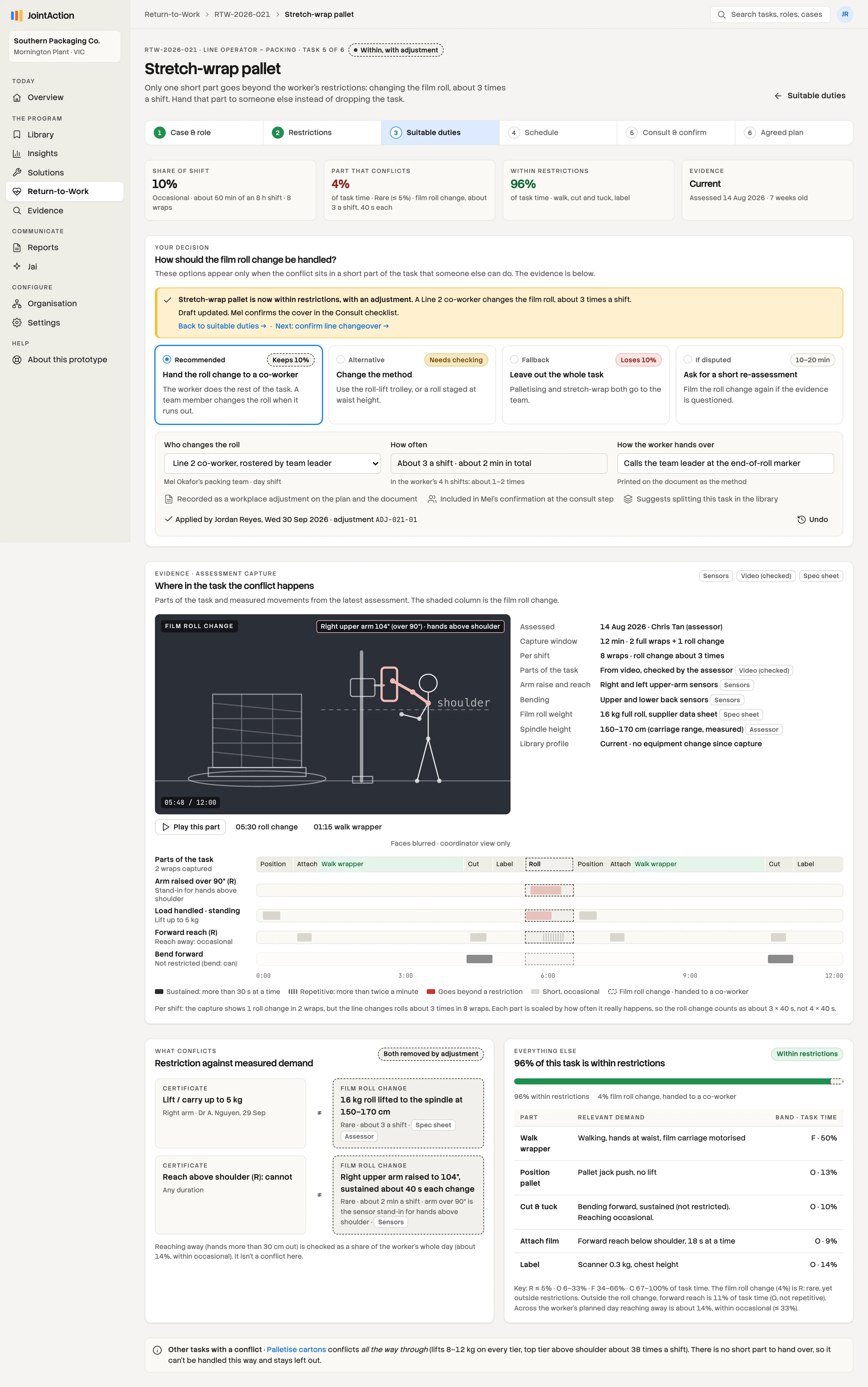
The RTW Matchmaker is designed to compare each restriction with the measured demands of each task in the role. The coordinator sees the measured value next to the limit, not a score, and only the items that need a human decision are left open.
Within restrictions
Every relevant demand is measured or confirmed, and inside the limit.
Outside restrictions
At least one demand breaks a restriction. Left out unless an adjustment covers it.
Needs confirmation
A relevant demand is missing, out of date or can't be measured. Unknown is never treated as fine.
Within, with adjustment
The part that breaks the restriction is handed to someone else, and the rest stays with the worker.
In this case
Carton packing, labelling and quality checks are within the worker's restrictions. Palletising is outside them: 8–12 kg lifts, some above shoulder. Two tasks need a decision.
Unknown becomes a question
Line changeover was last assessed before the line was re-tooled, so its working heights are unknown. The platform drafts three questions for the line manager. Their answers settle it for this case, and the task is queued for a short re-assessment.
The bands rehab providers use
Frequency limits use the familiar bands (rare, occasional, frequent, constant) and are checked across the whole planned day. Reaching away from the body adds up to about 14% of the day: occasional, inside the certificate's limit. Repetitive and sustained work is checked too, even when it's rare in total.
Inside a task
Often it's one part of a task, not the whole task.
Stretch-wrapping a pallet is mostly walking the wrapper and tucking film below shoulder height. About three times a shift, the film roll runs out and a 16 kg roll has to be lifted onto a spindle at 150–170 cm. It's rare, about two minutes a shift, but rare isn't the same as fine: that part breaks two of the restrictions. The rest of the task doesn't.
Because the assessment records the task over time, it can show where in the task the conflict sits. The coordinator can hand just that part to a co-worker, recorded as a workplace adjustment on the plan, and keep the rest of the task with the worker.
A rating of the whole task, the way most job analyses are written, would have taken the task away entirely.
Step 5 · Schedule
A graduated return, drafted for review.
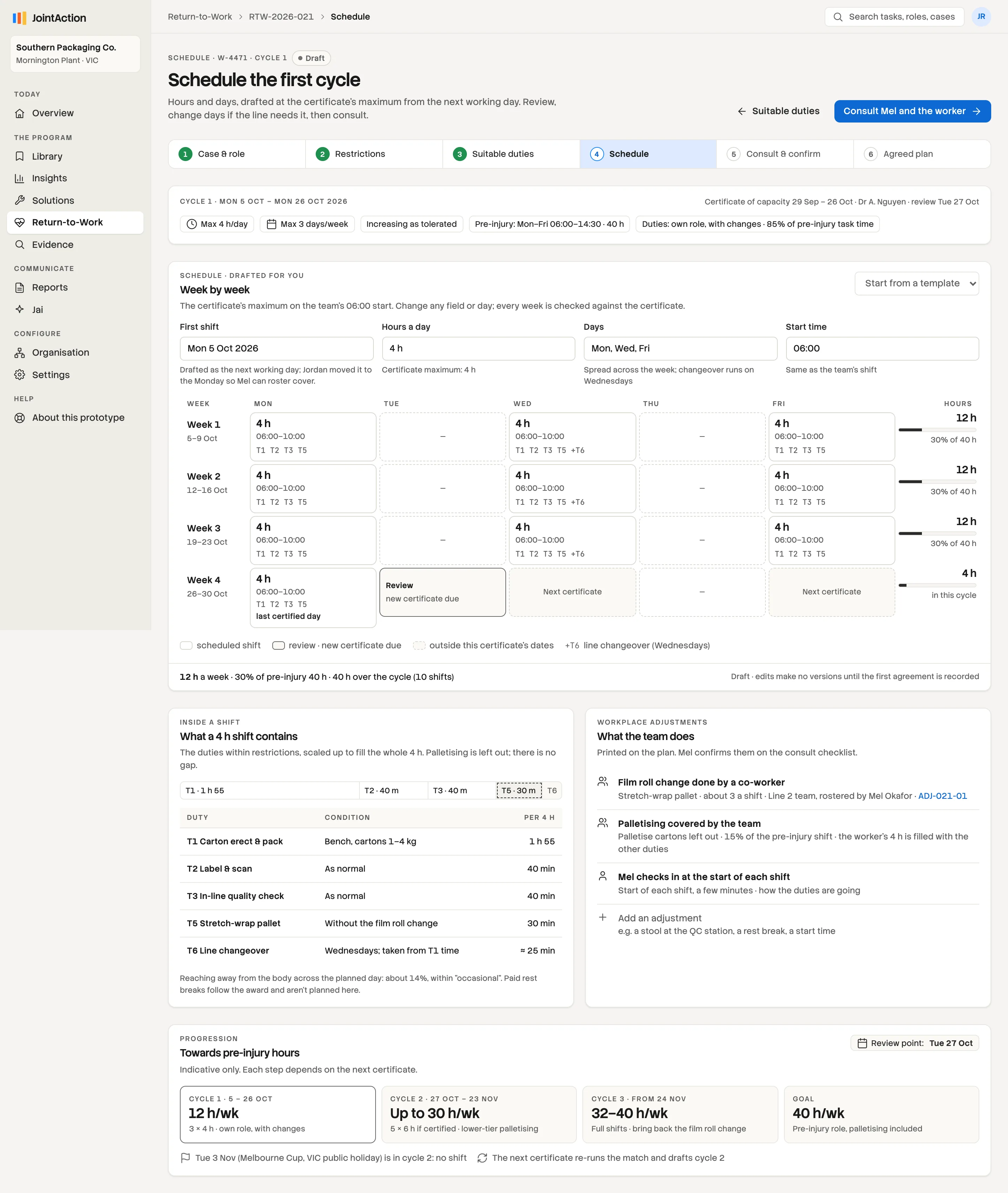
The platform drafts the schedule at the certificate's limits, here 4 hours a day, 3 days a week, from the next working day. It fills the hours with the duties that are within restrictions, so the coordinator starts from a draft rather than a blank page.
The schedule can't exceed the certificate, and the platform never trades hours against duties: the certificate sets the hours. Each cycle follows the certificate it sits under.
Step 6 · Agree
The worker and the line manager agree before the doctor sees it.
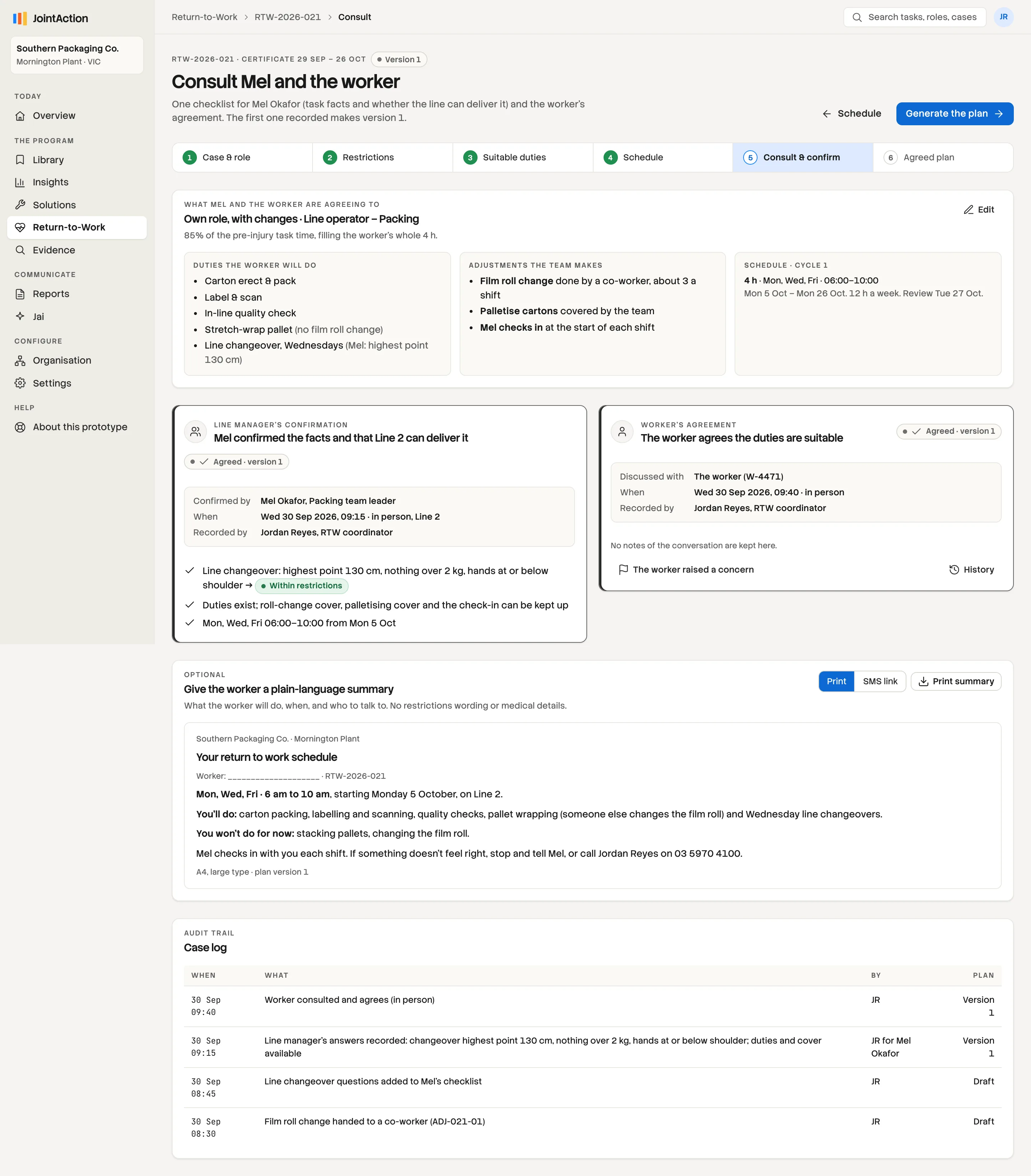
Doctors want to see that the worker has already agreed to the duties. So the coordinator talks the duties through with the worker, and the line manager answers one checklist: the duties exist, the co-worker cover is in place, the schedule works.
Both agreements are recorded against the exact version of the plan they were made on. Until the first agreement the plan is a draft that can change freely. After it, any change creates a new version and asks both people to agree again, but only about what changed.
- DraftDecisions change it freely
- Version 1First agreement recorded
- IssuedTo the clinic and the worker
- Version 2Only if something changes
Step 7 · Agreed plan
One page the worker and the coordinator have agreed.
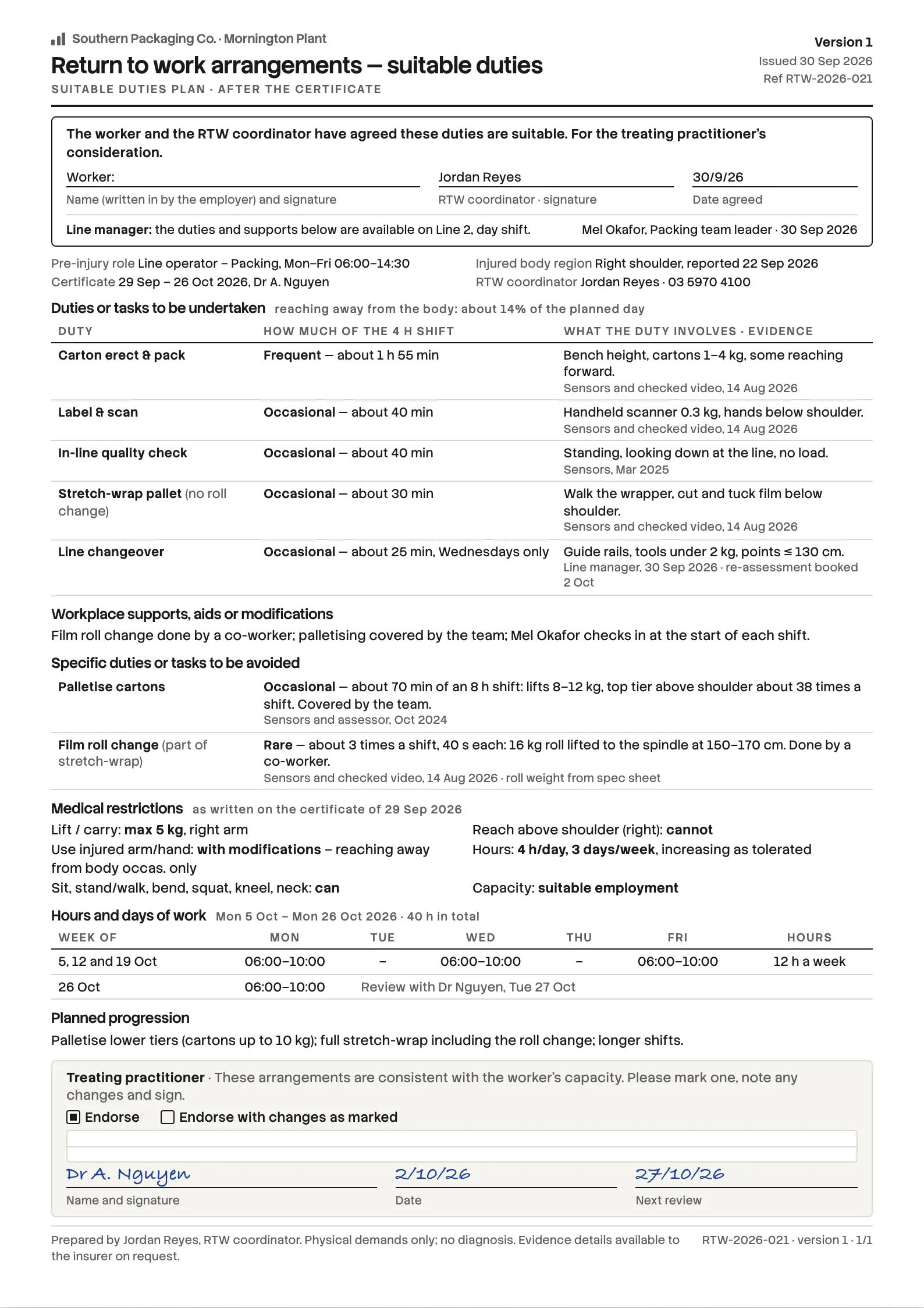
The plan opens with that agreement and both sign-off lines, then the line manager's confirmation. It lists the duties to be undertaken, the supports, and the duties to be avoided, under the field names of the state's return-to-work form, each with how often it's done and a plain evidence line.
Each section copies straight into the RTW form your organisation already uses. The platform supplies the suitable duties; it doesn't replace the form.
It goes to the clinic with the worker's consent, and the worker carries a printed copy. Duties that are within the current certificate start on the planned date. The doctor's response is recorded whenever it arrives, and any change the doctor marks opens a revision.
The full evidence trail stays on the platform, available to the insurer on request. The doctor gets the one page.
Step 8 · Next certificate
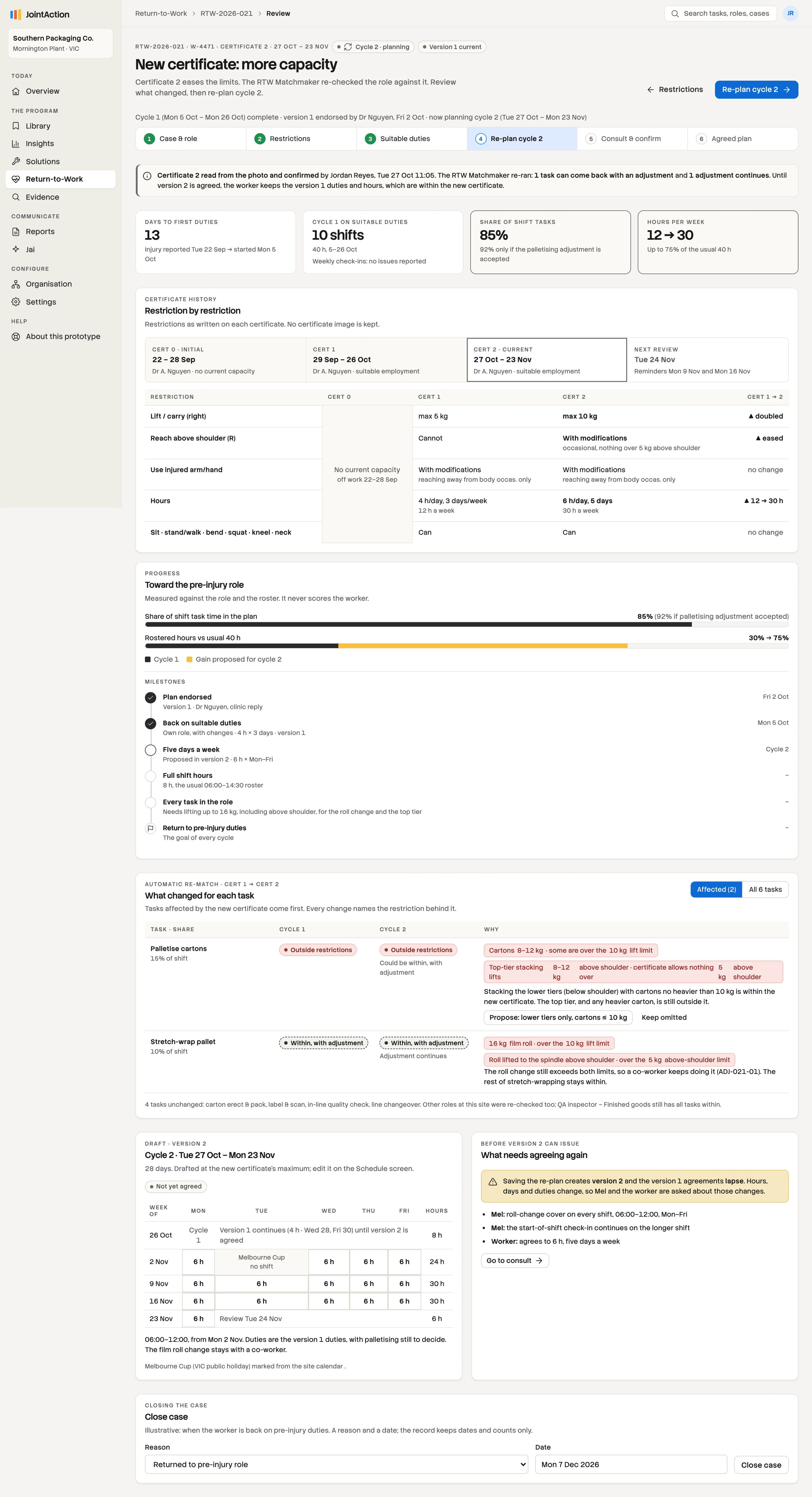
Each new certificate re-runs the match, not the whole case.
When the next certificate arrives, the coordinator enters it and the platform shows what changed: the restrictions side by side, the tasks whose result moved, and the share of the role now back with the worker.
Here the lifting limit rises from 5 kg to 10 kg and the hours to 6 a day, 5 days a week. Lower-tier palletising can come back with an adjustment. The film roll change still can't.
Before a claim
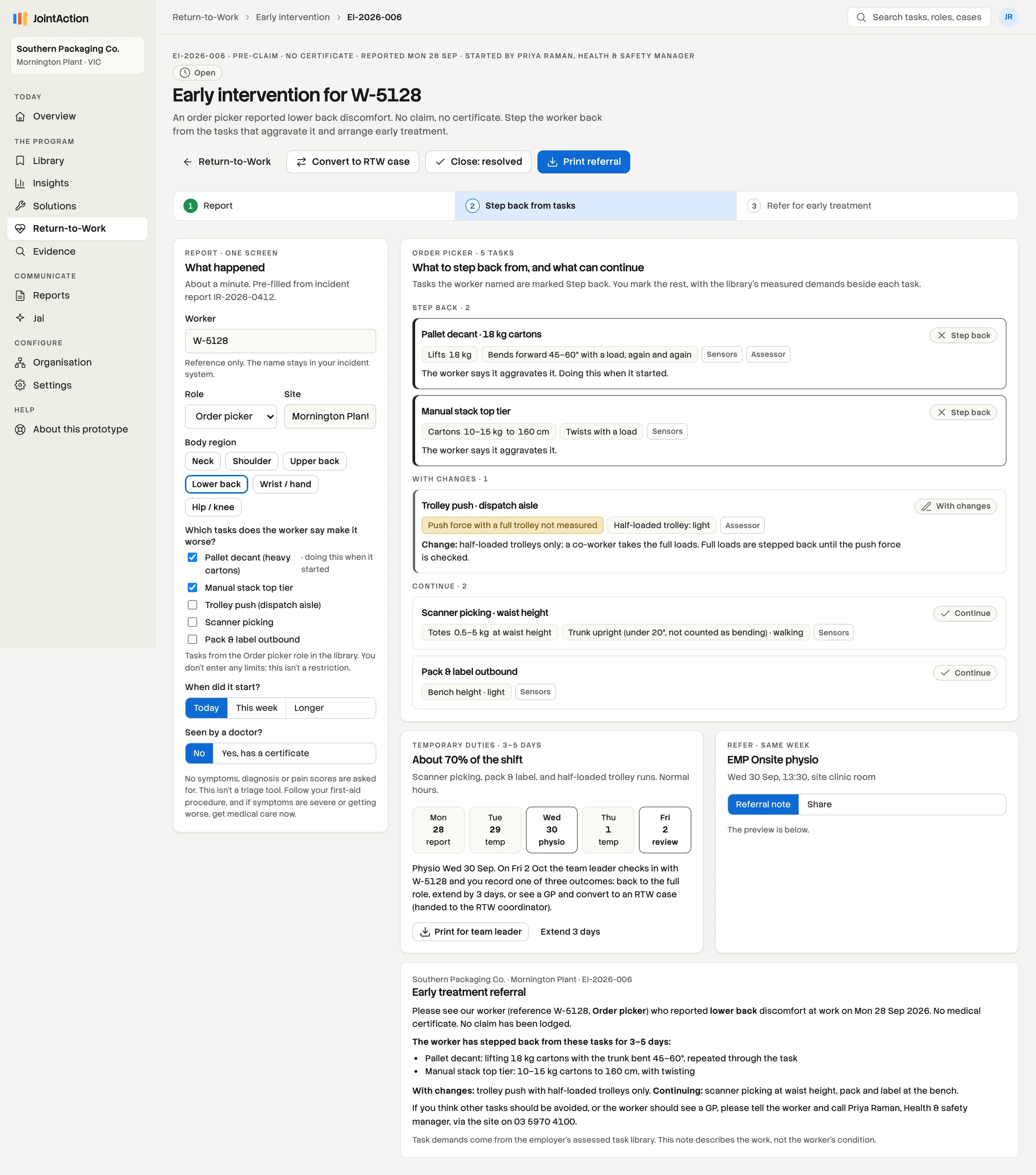
Early intervention when a strain is first reported.
Not every injury starts with a certificate. When a worker reports a strain and hasn't seen a doctor, the health and safety manager records the body region and the tasks the worker says make it worse.
The platform marks each task in the role as step back, with changes, or continue. Any task with unknown demands is a step back until it's checked. A referral note for early treatment lists the body region and the tasks to avoid, with no diagnosis. If a certificate follows, the record becomes a full case.
What powers it
The task demands library: the measured demands of the work.
Return-to-work matching is only as good as the demand data behind it. In Etiscope that data comes from assessments of the actual work, recorded with Etiscope Capture and organised into the tasks and roles of your sites.
Etiscope Capture
Assess the task
Five inertial measurement unit (IMU) sensors and optional video, around 10 minutes per assessment, in the real workplace.
Task demands
Demands, with sources
Postures, movements, loads, heights, and how often each happens in a shift, each with its source and date, approved by your library owner.
Role
Functional Demand Statement
Each role is the set of tasks a worker does, with the time each takes. Its Functional Demand Statement is built from them.
RTW matching
Plan, match, evidence
The same demand data feeds the plan before the appointment, the task-by-task match, and the evidence line on the agreed plan.
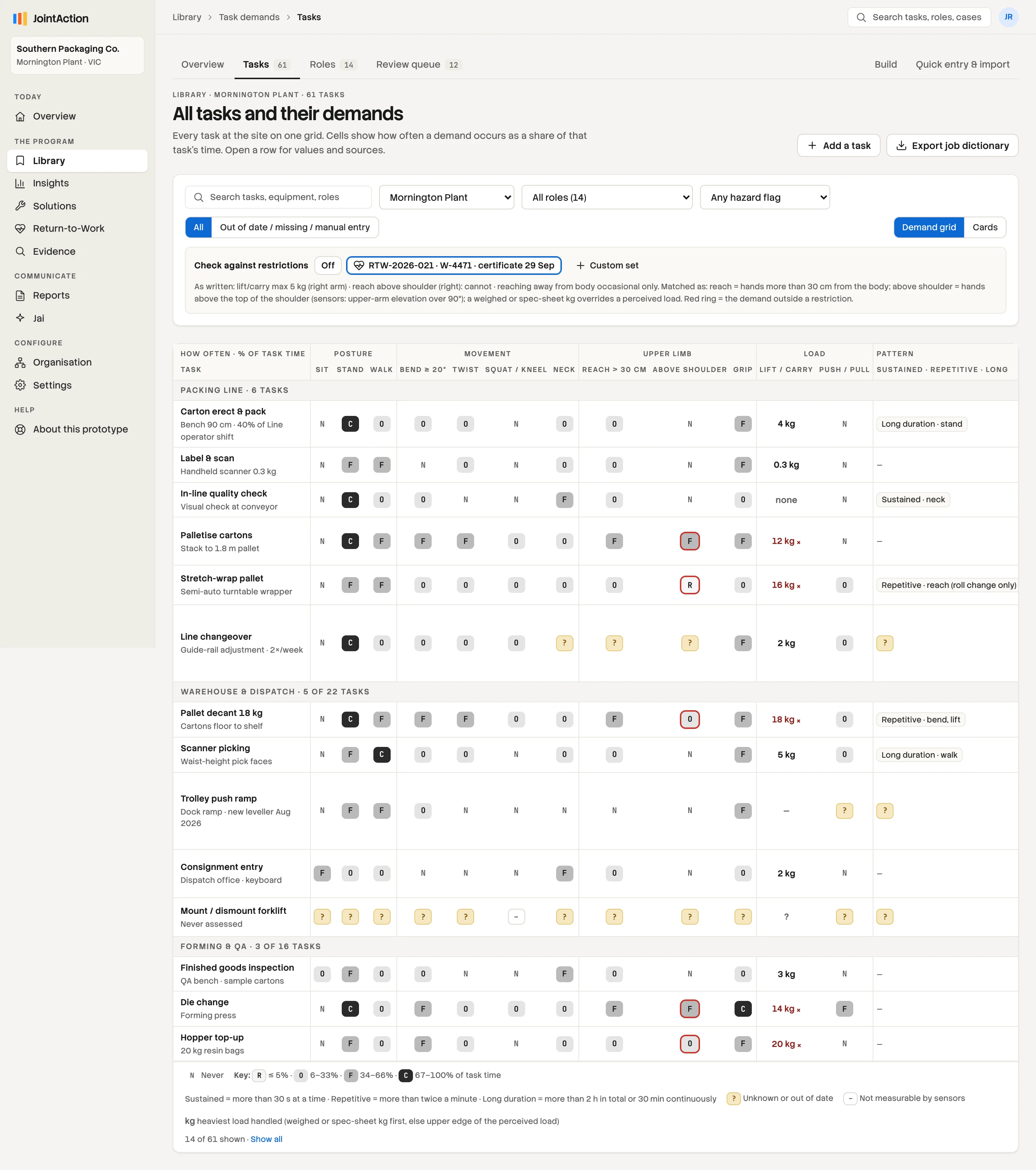
Every task on one grid. Check the whole site's tasks against a worker's restrictions to find duties outside their own role. Rare heavy events, such as a roll change three times a shift, are flagged even when they're brief.
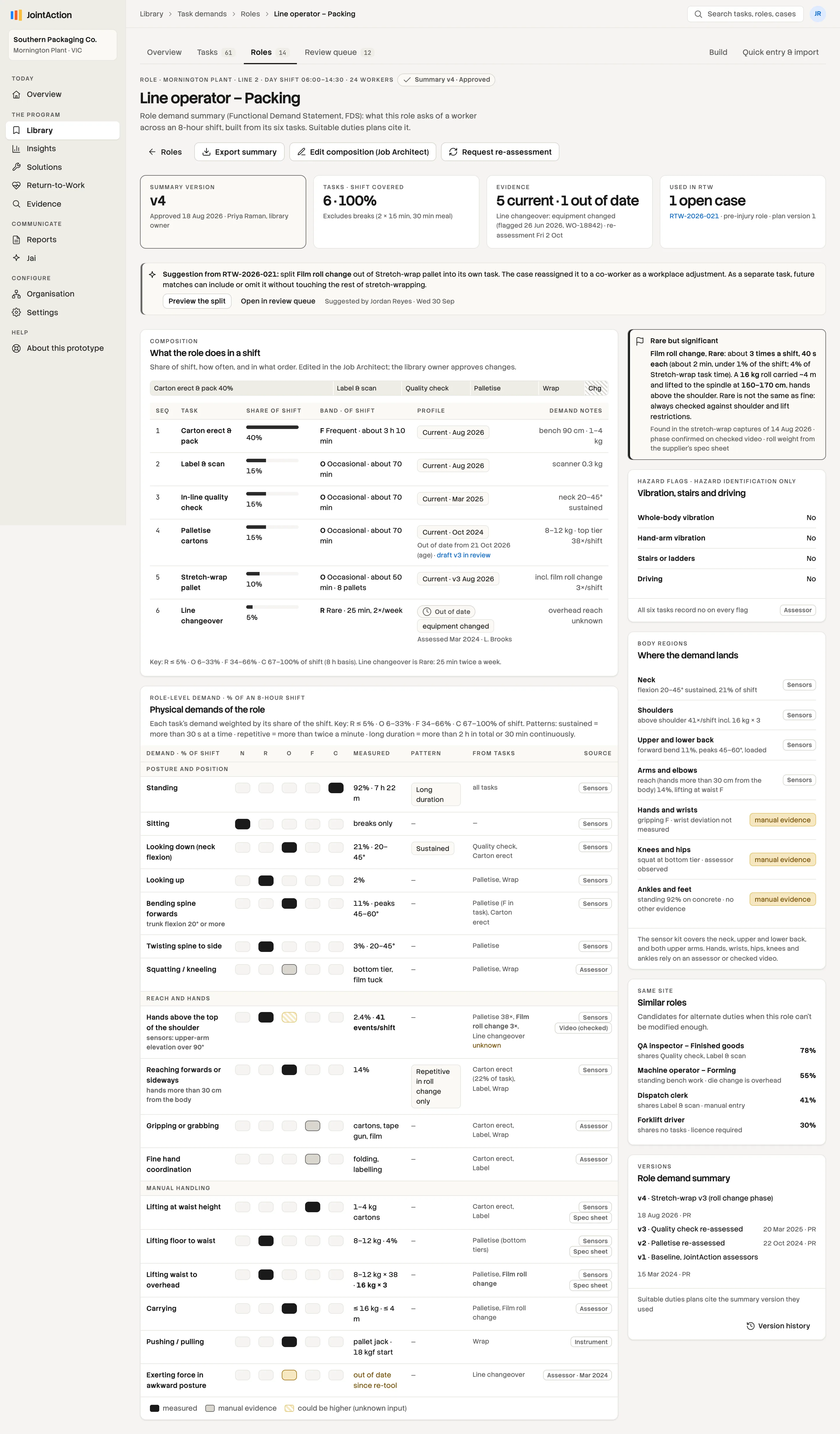
Demands that stay current. A task's demands go out of date after 24 months, or straight away when equipment or the task changes. Out-of-date demands come back as needs confirmation, never as fine. New customers can start with quick entry and replace it with assessments over time.
Design principles
Built to be defensible, and to be trusted by the people it affects.
The platform proposes; people decide
The coordinator chooses the duties, the worker and line manager agree, and the treating practitioner responds. Nothing is applied automatically.
Unknown is never fine
Missing, out-of-date or unmeasurable evidence never passes silently. It becomes a question with an owner.
Evidence with its source
Every result shows the demand behind it (kilograms, degrees, and how often in a shift: rare, occasional, frequent or constant) and where it came from: sensors, checked video, an assessor, a specification sheet, or the line manager.
Minimum personal data
No worker names and no diagnosis are recorded. A case has a reference; the worker's name stays on your own RTW form.
What it isn't
Focused on suitable duties.
It covers physical and musculoskeletal restrictions, and the duties and workplace adjustments that fit them.
Not claims management
It works alongside the insurer's claim process. It doesn't manage claims, payments, or liability.
Not a clinical assessment
It describes the job, not the worker. Capacity is the treating practitioner's call.
Not worker monitoring
No individual worker is scored or ranked. Outcome reporting is designed to be aggregate only.
Not AI deciding duties
The RTW Matchmaker is a deterministic platform workflow. The same restrictions and the same evidence always give the same result.
The regulatory context
Victoria's coordinators need support, not just training.
Victorian law now requires employers to train RTW coordinators and give them the facilities and assistance they need — with penalties for non-compliance. The obligations commence by 1 July 2027 at the latest.
Workplace Injury Rehabilitation and Compensation Amendment Act 2025 (Vic), ss 106A and 106E. Return-to-work matching is one way to give coordinators that assistance; the Act doesn't prescribe a tool.
Availability
Available today as an engagement.
The RTW Matchmaker module is in development as part of Etiscope, shaped with occupational rehabilitation clinicians.
Until then, matching is delivered as an engagement on top of your task demands library. If your program already has a well-assessed library, talk to us about piloting the module.